Abstract
Autonomous agents are a standard tool for animating groups, but the groups they produce are usually homogeneous: every agent runs the same behavioural model, so individual differences come from an agent’s momentary situation rather than from any stable disposition. Giving agents durable, distinct characters normally means hand-tuning each one’s low-level parameters, which is slow and rarely yields a coherent temperament. A known remedy is to drive those parameters from a personality model, so that a small, legible description stands in for dozens of settings; this has been used to add variation to simulated crowds. This report describes what happens when the same idea is carried out of the screen and into a physically realised setting: we used the five-factor (OCEAN) personality model to individuate the behaviour of twelve autonomous robots in a public art installation. We set out how each behavioural parameter is coupled to one or more personality axes, why the coupling — not the axes themselves — is where the expressiveness lives, and what we observed when visitors met the result over a months-long museum run.
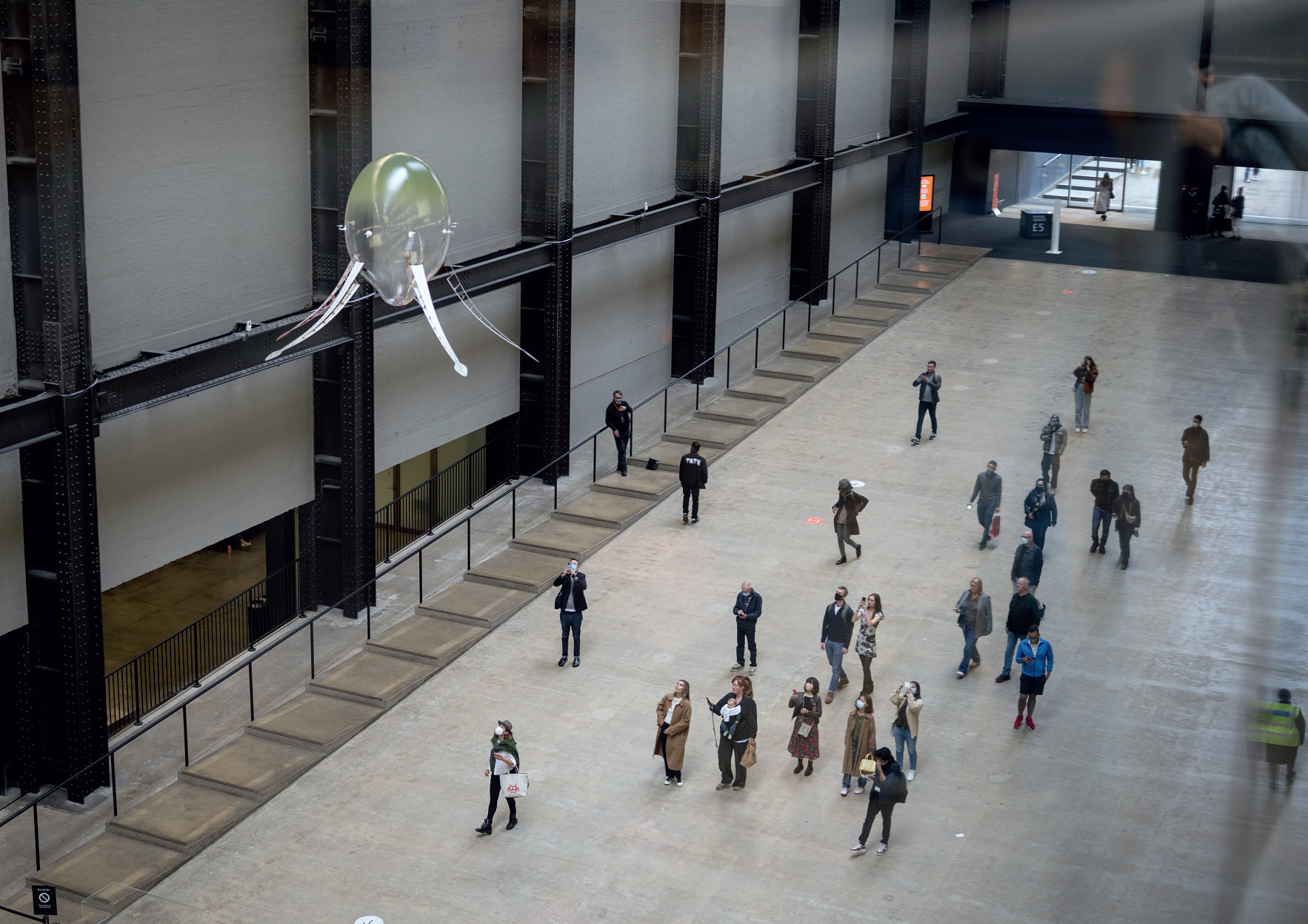
What the report documents
The technique itself — mapping the five OCEAN factors (openness, conscientiousness, extraversion, agreeableness, neuroticism) onto a behavioral model’s low-level parameters — was developed in crowd simulation, for statistically varied but anonymous crowds. This report’s contribution is the transfer: taking that mapping out of screen-based simulation and into twelve embodied, non-anthropomorphic robots meant to each read as a specific, recognizable individual, not an aggregate. It sets out the coupling logic — which parameters move together, and why the coupling is where the expressiveness actually lives — and reports informal but consistent observations from the installation’s months-long run: visitors readily assigned distinct, session-to-session-recognizable personalities to individual Aerobes, singled them out, followed them, and speculated about what a given machine wanted — treating its behavior as evidence of motive, not mechanism.
This is a companion report to An Aquarium of Machines, documenting the mechanism behind the “parameters mapped to personality traits” line in that paper, and behind the Tate Modern commission itself. Read the full report