Abstract
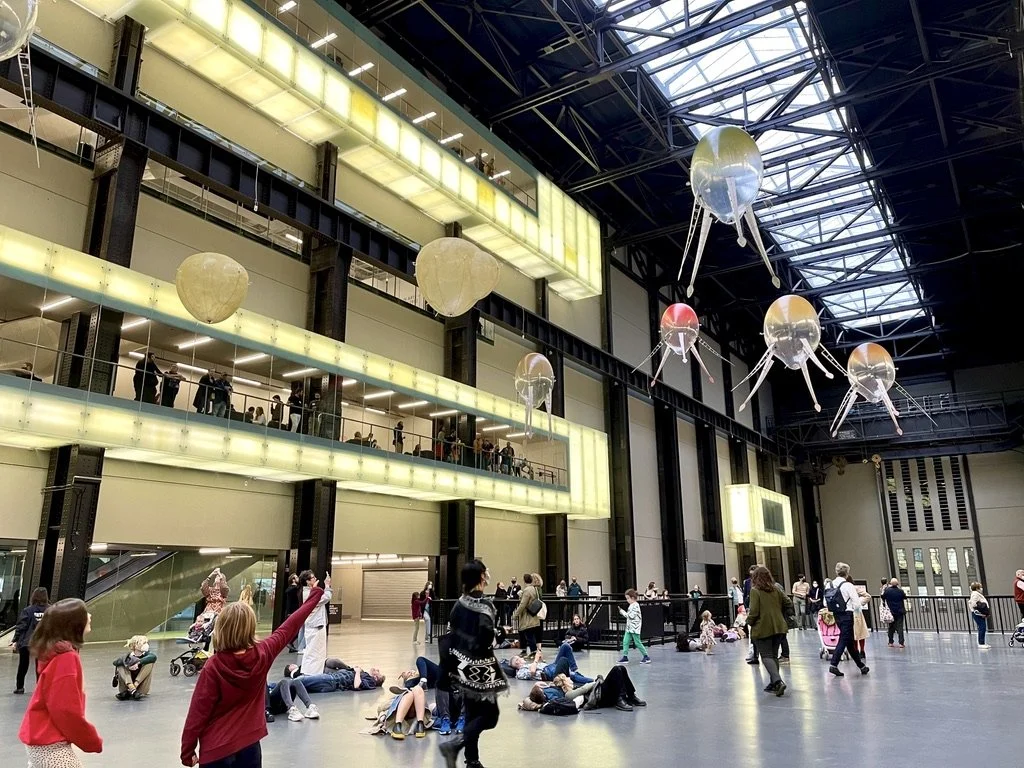
This paper describes the public art installation In Love With The World by artist Anicka Yi, which embodies a complex virtual ecosystem of autonomous agents in a physical space. The agents, called Aerobes, are inspired by the lifecycle of the Aurelia sp. jellyfish, and use artificial life techniques designed by the authors to simulate the behavior of two distinct phenotypes. These agents are embodied in the Tate Modern’s Turbine Hall using lighter-than-air soft robotics utilizing helium that can respond to museum visitors through sensors embedded in the space. By creating organic-looking fully autonomous agents that are capable of real-time interaction, we hope to create an experience that causes viewers to question what living with machines might feel like in a speculative far-future, and to imagine an alternative form of artificial intelligence that is neither threatening to humanity nor subservient to it, but exists in an altogether parallel track as a new form of life.
What the paper documents
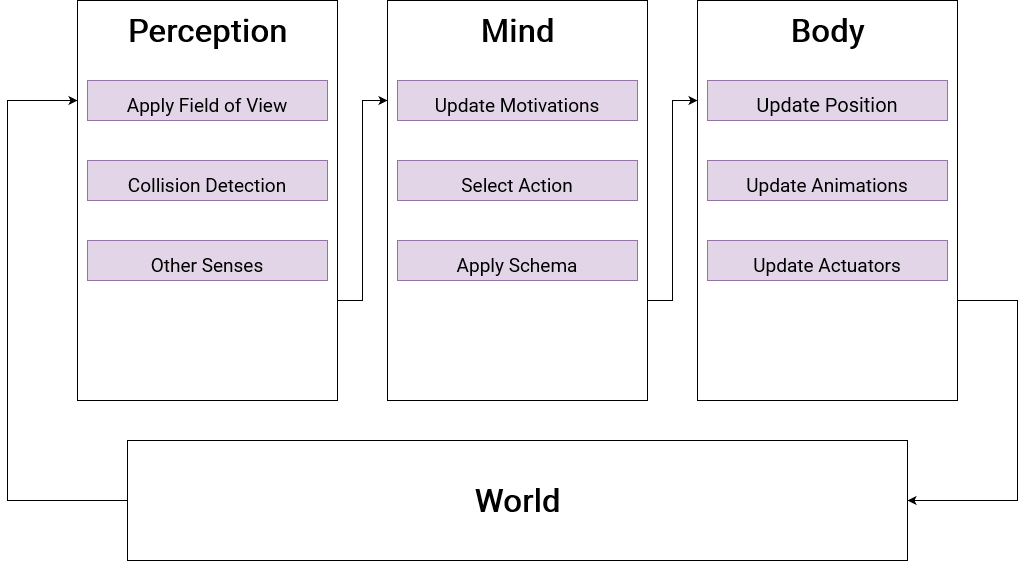
Each Aerobe decides how to move using a three-layer architecture — perception, mind, and body — running in a continuous loop against the state of the physical world. Motivations drive what an Aerobe wants; schemata translate that want into a concrete behavior; the body layer executes it as motion, animation, and actuator commands. The paper documents this architecture and what it took to keep dozens of genuinely autonomous machines running continuously, in public, for four months, without a human operator in the loop.
This work underlies the behavioral-modeling capability in our discipline, and is the technical foundation behind both the original Tate Modern commission and its extension to the New Museum. Read at ACM Digital Library · preprint
Companion talk
Creating Life-like Autonomous Agents for Real-time Interactive Installations — ACM SIGGRAPH 2022 Talks. A companion technical talk on the same Aerobe system, presented at SIGGRAPH 2022 alongside the paper above. Read the talk
Companion technical report
Modelling Autonomous Agent Psychology Using Personality Traits — a self-published Sitara Systems technical report documenting exactly how each Aerobe’s “motivations” layer is generated: the five-factor (OCEAN) personality model, coupled to the low-level motion parameters this paper only summarizes. Read the report